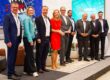
The kick-off event of the NIBRA Future Talks on 29 September 2026 in the Vienna Grand Gallery was dedicated to the topic of “Green Building in Residential Construction: New Construction, Refurbishment, Affordability and Operation in Interaction”.
“The future of construction lies in holistic thinking: If planning, construction and operation are understood as a unit, buildings are created that are economically convincing, have a sustainable effect and function reliably in the long term.” Host Nikolaus Brada, owner of NIBRA, thus set the framework for the first NIBRA Future Talk. On this evening, top-class panel guests discussed how affordable housing, rising construction costs, renovation needs, climate goals and operating quality can be implemented together, supplemented by the question of financing.
Dr. Claudia Brey, Managing Director of ÖBB-Immobilienmanagement GmbH, presented some exciting projects that have been developed on ÖBB building sites. These became available because the demands of the railway infrastructure have changed significantly in recent years. This has made it possible to create new urban quarters, e.g. in the Sonnwendviertel, at the Nordbahnhof and the former Nordwestbahnhof, quarters which are also intended to meet the requirements of the residents and ÖBB now and in the long term concerning e.g. educational opportunities, local amenities and free green spaces.
Mag. Peter Engert, Managing Director of ÖGNI, called for a considerable acceleration of construction procedures, because long waiting times are no longer financially feasible in the current interest rate phase and under the volatile market conditions. Good progress is being made with the building certifications that ÖGNI offers in association with some other European countries. The renovation of existing buildings, which make up the majority of urban architecture in Europe, remains challenging. In addition, he emphasised the importance of resilience in connection with living in urban areas and necessary green spaces as well as climate-friendly housing.
Michael Gehbauer, Chairman of the Austrian Association of Non-Profit Building Associations, emphasised the importance of sustainable recyclable materials, such as clay, sheep’s wool, hemp and wood. Although Vienna has a lot to offer concerning non-profit sector real estate by international standards, there is still room for improvement. He therefore called for bigger investments, affordable land and reliable framework conditions.
Foad Ghaemi, Director of Wealth Management at Alpen Privatbank AG, reported that banks are confronted with high regulatory requirements and have only limited room for manoeuvre for financing. He also called for a significant reduction in approval procedures on the part of politicians so that construction projects can be implemented more quickly and efficiently before the framework conditions make subsequent adaptations necessary.
Prok. Ing. Sascha Risavy , Head of the Construction Management Department at the Austrian Housing Association, shed light on the technical side and emphasised the importance of considering renewable energy, technical standards and sustainable building materials as a basis in planning and implementation in order to be able to design the highest possible quality objects. Industrial prefabrication of components in order to reduce construction times should also be promoted. In addition, all alternative options must be exploited for the CO2 footprint of buildings in order to reduce costs and dependencies on highly fluctuating world markets.
Using the example of the B.R.I.O. residential project in the Neues Landgut district, it was illustrated how these topics interact. Timber hybrid construction, high prefabrication and a renewable energy system meet barrier-free accessibility, technical quality and long-term use. NIBRA implemented the elevator systems. The example makes the NIBRA perspective concrete: Green building does not end at the building envelope. It has to prove itself in daily operation.
The results of the NIBRA Future Barometer, which was used for the first time at the end of the event, will be evaluated separately and incorporated into the continuation of the format.
The evening was opened by the district head of Donaustadt Ernst Nevrivy. The discussion was moderated by Dr. h. c. Wolfgang Renner, MSc.
NIBRA deliberately brings in the perspective of long-term building operation. The Viennese family-owned company builds, modernizes and maintains elevators and thus accompanies technical infrastructure over many years in operation. Brada summed up the claim of the format as follows: “To bring people together, to have conversations, to exchange experiences and to look to the future together.” The message: Sustainability must prove itself not only in construction, but also in daily operation.
Photo credit: Magdalena Sowka-Gruszecka